
Oklahoma Legislature: How to Contact Your Representative
Have you ever wondered how to contact your agent? Here's what you should know.
A campus is being built west of downtown that will house services to support people going through the justice system, alongside new supportive housing and a mental health and addiction treatment recovery center.
For the past 40 years, the oddly shaped block at Linwood Boulevard, Western Avenue and NW 6 has been a largely abandoned stretch of abandoned buildings and dilapidated properties that formed a clear boundary to downtown.
But as federal mental health support fails to keep up with the growing population, Oklahoma City and the Arnall Family Foundation are beginning to transform the area to provide a potential boost for those unlucky and in need of help.
The Arnall Family Foundation launched the Diversion Hub in 2018 as a pilot program with the goal of connecting people trapped in the legal system with a range of social services designed to provide an alternative to incarceration and reduce recidivism.
The MAPS 4-funded home for the Diversion Hub, currently operating at 220 NW 10, is already under construction on land the foundation purchased on Linwood Boulevard. Sue Ann Arnall, who founded the foundation in 2015, said the hub was not enough to do the work.
“When we started the Diversion Hub, the police were an integral part of the planning and they wanted the Diversion Hub to be open 24 hours a day so they could drop people off,” Arnall said. “But it just doesn’t work that way because we don’t have mental health or trauma specialists.”
At that point, Arnall expanded the acquired land along Linwood Boulevard and offered to donate a house for the Restoration Center, another MAPS 4-funded project.
She also donated land for supportive housing, funded through MAPS 4, which will follow the design and construction of the restoration center. And on the west end of the block, at 1318 Linwood Blvd., the foundation renovated an old warehouse that opens Thursday as a home for Curbside Enterprises and the Neighborhood Services Organization's Stay Housed Tenant Advocacy Center.
“The restoration center is the hub of everything,” Arnall said. “Now when the police take people to jail for trespassing, crossing the street improperly or whatever, the police have no choice but to take them to jail. And that is absolutely the wrong place.”
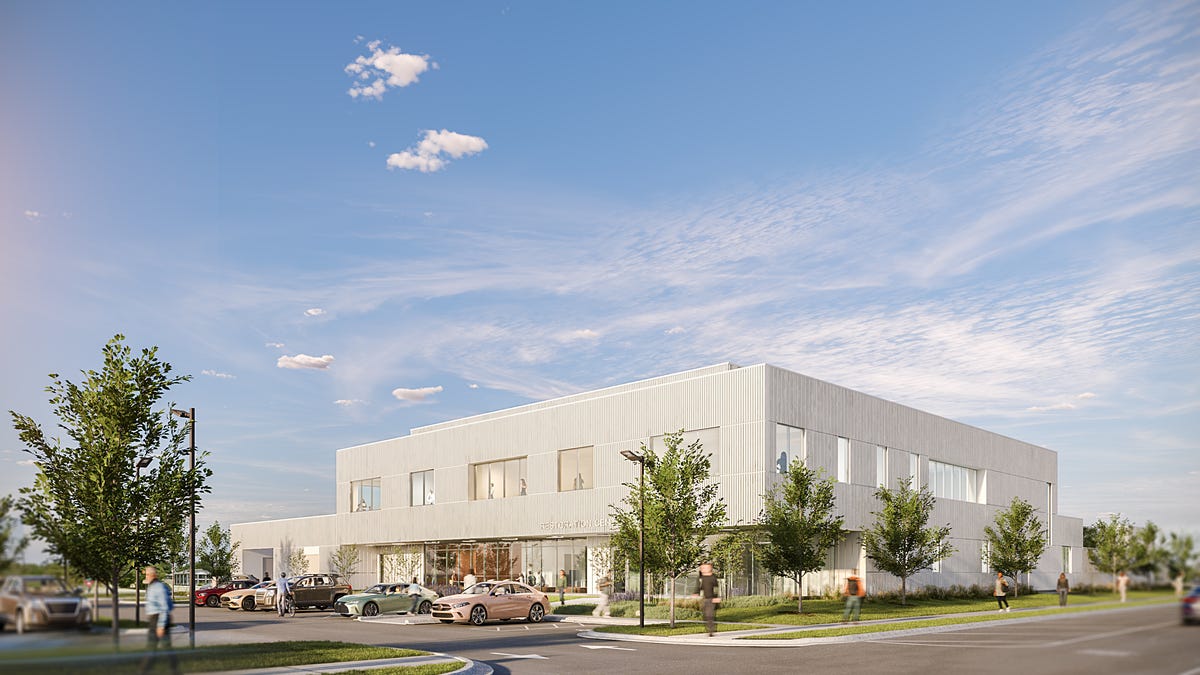
Preliminary designs for the $24.54 million restoration center were recently approved by the MAPS 4 Citizens Advisory Board. Construction is scheduled to begin in 2026.
The facility will include 16 crisis beds and eight emergency beds. The 34,000-square-foot building is designed to include an emergency center intake area with lockers and storage, rooms for up to 23-hour observation, and a crisis stabilization unit with a quiet room, a lounge, a family group room, and a dining and playroom. The designs also include a medical detox and sobering center with a nurses' station.
“Police will be able to drop people off and that will keep them from going to jail and staying out of custody because NorthCare operates the second floor where they do walk-ins and people in an outpatient type of service.”
Ideally, Arnall said, those arriving at the recovery center would be stabilized and transferred to the diversion center.
“A lot of people who go there also have warrants for failure to appear, and that happens because they are unable to organize their lives,” Arnall said. “This will help many people get out of the vicious cycle of the criminal justice system. It seems to be an answer to many of the current problems.”
Arnall said about 65% of those arrested are being held at the Oklahoma County Detention Center on failure to appear warrants.
It is not lost on Arnall that the shape of the block being converted into a recovery hub is in the shape of half a heart. The foundation has acquired additional land on the block that is not yet earmarked for new development but is intended for service provider operation.
“We’re trying to help solve a problem,” Arnall said. “Proximity is very important.”
In addition to building the restoration center, the city will also begin construction in early 2026 on the $12.27 million Robert Ravitz Crisis Center, to which the Arnall Foundation is contributing $2.35 million.
The Ravitz Crisis Center, 1200 NE 13th St., on the east side of the OU Health Sciences Center campus, is designed to provide space for assessment, detoxification, crisis de-escalation, counseling, recovery and adequate sleep. It will be operated by the Oklahoma Department of Mental Health and Substance Abuse Services.
Questions remain about funding the full operation of the restoration center. Arnall said the Legislature and the Department of Mental Health must continue to fund operations on the first floor of the Restoration Center.
Oklahoma City Mayor David Holt points out that while the city and the foundation are working together to improve the community's response to mental health and addiction, they don't have the resources to take on what has historically been the role of the state.
“The Oklahoma State Department of Mental Health and Substance Abuse’s annual budget is larger than the entire 10-year MAPS initiative,” Holt said. “It's really important to understand that we can't possibly close the gaps. These are responsibilities that have existed at the state level for as long as we've all been alive. But can we contribute to better mental health? Can we help keep people out of prison? Absolutely.”