In the United States, 15 million hair ties are thrown away every day. A student just won $15,000 for solving this plastic problem.
SAN DIEGO – Fifteen million hair ties are lost or thrown away every day in the United States alone. For USD student Sage Dobby, this startling statistic sparked an idea that just earned her a $15,000 scholarship.
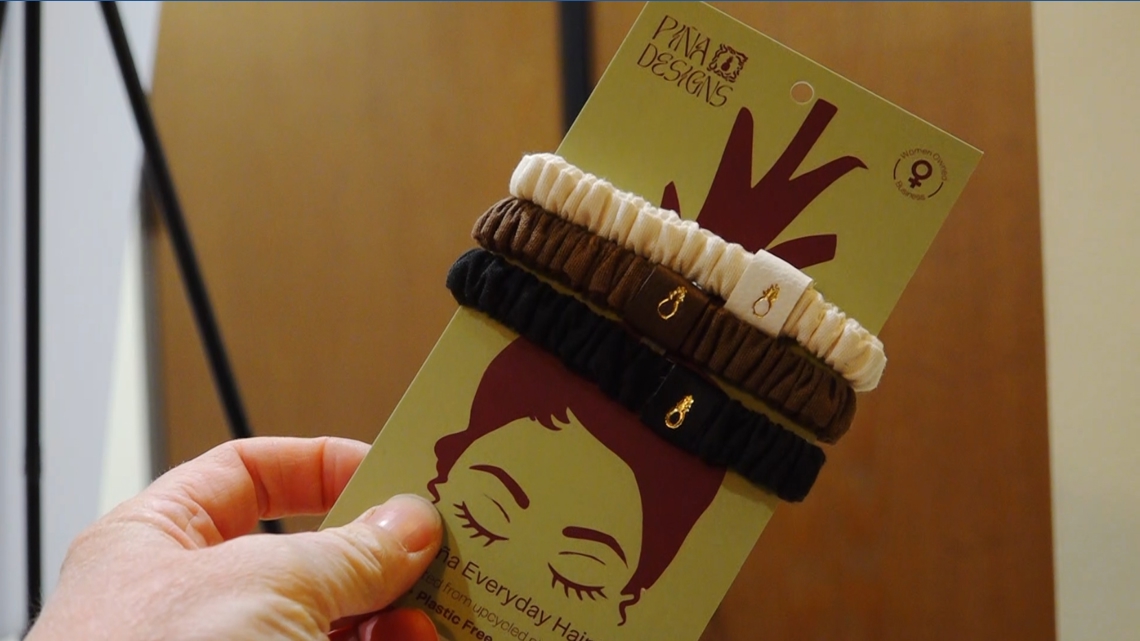
Dobby co-founded Piña Designs, a company that creates the world's first biodegradable, plastic-free hair ties from discarded pineapple leaves. On Friday, she presented her sustainable solution at the University of San Diego's 7th annual Fowler Business Concept Challenge and took home the top prize.
“We wanted to create a product that would help women have healthier hair, but when they lost the hair tie, it didn't have a negative impact on the planet,” Dobby said.
From pineapples to hair ties
The concept was inspired by a co-founder's Filipino experience weaving pineapple fiber. Eighty percent of a pineapple is typically thrown away when harvested, Dobby explained. In Southeast Asia, these agricultural wastes are often burned, creating a yellow haze that causes health problems.
Instead, Piña Designs recycles these leaves. The fibers are stripped, sun-dried, spun into yarn and woven into fabric. The hair ties are also made from natural rubber from rubber trees and organic cotton and are therefore 100% biodegradable.
A three-pack costs $14.99 online and a six-pack costs $29.99. So far, the company has achieved zero returns and 100 percent customer satisfaction, Dobby said.
Competition highlights student innovation
Dobby was one of 16 semi-finalists will compete in the Fowler Business Concept Challenge on Friday. All teams received $1,000 scholarships, with the top four receiving additional prize money from a total pool of $45,000.
Innovations ranged from AI-powered career simulators to marine genomic drug discovery – all developed by undergraduate and graduate students across campus, including USD's Knauss School of Business, Kroc School of Peace Studies, Shiley-Marcos School of Engineering and College of Arts and Sciences
Naomi Debass, a student at USD's Knauss School of Business, placed fourth with DialVR, a virtual reality platform that helps students learn about careers before they commit to them.
“You may be really good at medicine, but if you don't have a good patient-doctor relationship, you won't be successful at it,” Debass said. “We want to make sure people understand what this job actually entails.”
Real world mentoring
Students prepared their pitches throughout the semester under the guidance of faculty, staff and real-life entrepreneurs through the US Dollar's Brink Small Business Development Corporation.
Robert Rakowski, clinical professor of entrepreneurship at the Knauss School of Business, said the experience goes beyond winning scholarships.
“This experiential learning is embedded in them,” Raczkowski said. “It becomes part of who they are as professionals who are evolving to develop good for this world and be true changemakers.”
Building a sustainable company
Dobby, who is pursuing a master's degree in social innovation at the Dollar's Kroc School, founded Piña Designs two years ago with four other students at the University of Colorado Boulder. What started as a hobby has developed into a full-fledged business.
“At the heart of everything we do are our values,” Dobby said. “We seek a world where people, planet and profit can coexist.”
The company has sold more than $16,000 worth of products to date, with 33% of sales coming from repeat customers. Dobby said the team now wants to expand, get into major retailers like Whole Foods and Target, expand product lines and secure a patent.
To put the 15 million scrunchies per day in perspective, Dobby told the judges, “That's the equivalent of 227,273 empty jars of peanut butter – or about the weight of five full-grown elephants' worth of scrunchies.”